
2026 Dutchess County Poet Laureate


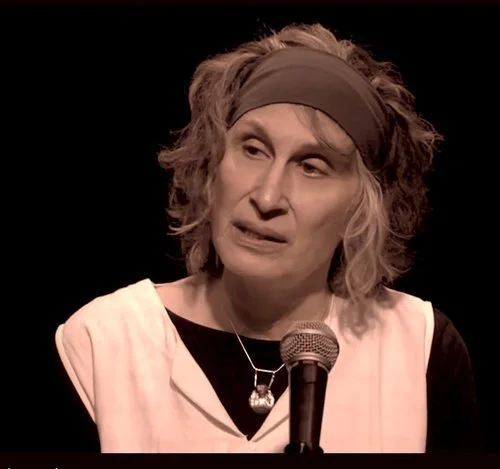
Ruth Danon
-
Ruth Danon’s fourth book of poetry, Turn Up the Heat, was published by Nirala Series in 2023. Her prose and poetry have appeared in many publications in the United States and abroad, most recently in On the Seawall, Noon: The Journal of the Short Poem,Sunday Salon Zine, The Nu Review, and TheCAPS 25th Anniversary Anthology. Her work is forthcoming in Pratik, The Beltway Quarterly, and the Poetry is Bread Anthology, She has performed her poetry across the United States and abroad and has appeared in many podcasts and zoom readings For 23 years she taught in the Creative and Expository Writing Programs she designed and directed for NYU’s School of Professional Studies. Founder of Live Writing: A Project for the Reading, Writing, and Performance of Poetry, she teaches for Live Writing and New York Writers Workshop. A Bard College graduate, she now lives in Beacon, NY, where she curates literary events and works to create a community of poets. She was one of the founding curators of the BeaconLitfest@the Howland. More about her and her poetry and career can be found at https://www.ruthdanon.com/
Upcoming Events
-
Poetry as Protest and Political Action
March 26th, 2026 at 7:00 PM
at The Beahive
6 Eliza Street, Beacon, NYA gathering of poets and interested community members to share thoughts, ideas, and poems relative to the serious events of our time.
-
Reading at Lagrangeville Library
April 1st, 2025 at 6:00 PM
at LaGrange Association Library
1110 Rt. 55, Lagrangeville NY 12540Ruth Danon will read her work and engage with the audience at the Lagrangeville Library
Poet Laureate Corner
-
Hello readers,
It’s almost March and time for another letter from your friendly Dutchess County Laureate. It’s been a hard winter so far and I hope everyone has managed the cold and snow without incident.
In what must have been the second or third grade we were all asked to answer the question “What do Daddies do all day?” We were supposed to answer this assumption loaded question with details about our fathers’ occupations. My problem was that I didn’t know because my father didn’t live with us and the breadwinner in my household was my doctor-mother. When I explained this at school, I was told that “mothers can’t be doctors.”
This memory came after I started thinking about that readers might wonder about Poets Laureate. What DO they do all day? Next month is National Poetry Month and I will focus on actual poetry, so I thought that this month I would tell you a little bit about what I do as Laureate and some of what I will be doing in April, which will be a busy month.
So – what do I do as Laureate?
Well, do a lot of what helped me get nominated for the role in the first. Yes, I write and publish and give readings – but above all the Laureate is active within the community she represents. So, I curate readings and events that I hope will interest different audiences. Curating not only involves designing the event, asking poets to participate, raising grant money from Poets and Writers to pay the artists. I believe that poets should be paid for their work and so I do my best to see that this happens. At 7 pm on April 17th I’ll be presenting 4 poets who are also book publishers. This event will take place the Howland Cultural Center in Beacon. John Yau (Black Square Editions,) Elizabeth Murphy, (Grid Books,) Michael Broder (Indolent Books,) and Stephen Motika (Nightboat) will read their work and discuss the relationship between their work as poets and their experience as publishers.
One project I’m developing along with a number of other curators in both Dutchess and Ulster County excites me a great deal. We are working to present marathon readings of the United States Constitution. Writers and performers will each present a portion of this crucial document. I’m thrilled to say that Professor Beau Breslin, a professor of Constitutional history and law, and who you may have heard on WAMC’s Round Table, will provide interpretive commentary as the readings progress. I believe that poets must address the very concerning events of this moment in history without resorting to polemic or propaganda. While these are not “poetry readings” they are a way for the Laureates among us to make meaning at this time. My hope is that these readings will help our communities understand what we are defending when we say we are “defending the Constitution.”
In April I will be the interlocutor at a launch of a memoir by a colleague and friend. I’m reading the book now and am wowed. It will be a pleasure to be in conversation with Donna Minkowitz about Growing Up Golem. This event will be at 7pm April 10 the at the Howland Cultural Center in Beacon.
And on April 1 I’ll be reading my own work at the Lagrangeville Library. (Wednesday, April 1st at 6:00 p.m. LaGrange Association Library. 1110 Rt. 55, Lagrangeville NY 12540.) You need to register through their website and space is limited.
On April 3rd I’ll feature for Calling All Poets.
(Details about all these events and others will appear on the Laureate page of the Arts Mid-Hudson site)
Not all the work of a Laureate is public. Twice a week I teach so I put a great deal of time into developing class plans. Just before starting to write this note, I mailed off a letter of recommendation for a student I am mentoring. She is applying to graduate school and I have worked with her to get her application in order. In the next room is the draft of a book a fellow writer has asked me to read and comment on. I’m almost finished reading it. Another person I’ve mentored wrote me this morning asking for blurb (supporting statement) for her first full length collection of poems. Of course I said yes and while I was writing this note to you she sent me the manuscript to read. Both very quiet forms of Laureate activity.
Watching audiences come to events and students succeed gives me enormous pleasure and satisfaction. All of the work, public and private, requires constant attention and engagement. That’s the life of this Laureate.
See you in April.
-
Hello all,
It’s a cold, hard winter and yet February is the month when we celebrate Valentine’s Day, a day of love. True enough, but I am not going to write about love poetry, its history (it’s old), its variety (it’s complicated), or its ubiquity (too many) and not even its pitfalls (so prone to cliché.)
Rather I want to write about the poet’s (at least my) hate and love of poetry. I had a student many years back who said to me: “Writing poetry is the thing I hate the most that I love the best.” And quite famously, it has been said by more than one writer “I love to have written.”
In other words, the relationship between many poets and their making of poems can be fraught. A writer like me, who writes into the unknown, is inevitably venturing into risky territory. If I go into the dark woods or even a vast open prairie, I don’t know what I will find. I might find something I didn’t want to find or know, a proud, antlered elk or a silly goose. I might even find a bear. I might find what is preoccupying me even if I don’t know what it is before I write the words.
The blank page beckons and all my desire to fill it with the “right words in the right order” could be stifled by my fear of what I might find – that is the real terror of the blank page – not that I won’t write anything (the weather is a surefire starting point) but that what I write might be revelatory in ways that are hard to bear. So difficult that it might yield tears. That’s what Frost said – “no tears for the writer no tears for the reader.” What might be lurking there, just beyond conscious awareness, should be surprising (a gift) but can also be disturbing (also a gift, though of a different kind.) And yet I can’t resist the seduction. We want to know. That is the desire that we poets (at least I,) yield to. To allow such desire is to risk disappointment. (the poem might be bad or contrived or untrue, even after I open up to the page.) And no one wants to be disappointed. The precarity created in the tension between fear and possibility is what I (and other writers) live with. Sometimes I just hate that precarity.
What I love, though, to quote the poet Jenny Boully, is that in writing a poem (or anything, even this little essay) “one starts out with nothing and ends up with something.” Something that had never existed before the writing began is now a “something” in the world. (I had no idea Jenny Boully would pop up just then. Nor did I know how much this essay would employ parentheticals!) But the pleasure of such surprises is irresistible, And the possibility of sharing surprises with readers is also irresistible. It’s two layers of love – the love that goes into the writing and the love that sharing the writing with readers reveals.
The poem is where the writer and reader meet. The most interesting poems engage the reader in an act of co-creation. As I’ve said before – poems (at their best) don’t deliver a message. They create an experience that the writer and reader share. The poem achieves its fulfillment when the writer and reader come together. Writers need readers. Readers need writers. That is love. That is a kind consummation.
Just recently, after focusing on prose, I’ve returned to the practice of writing poems almost every day. Yesterday, sure that I had nothing in me but exhaustion, I began to write. My first words admitted my fear that I had no words:
I wish I had
words
but I don’tSeems like my impasse was with writing itself. It seemed so to me. But then, this happened:
I wish
a wash
of tears
would come
but they don’t
I wish it weren’t
a cold climate
but it isI wish the dead
had not died
in a cold country
but they didI discovered in just a few lines my inarticulate and helpless grief about the terrible events in Minneapolis over the last few weeks. That was my first discovery.
The second discovery was that almost all the words were monosyllables and so in revision I moved towards making the entire poem monosyllabic, revealing a speaker barely able to get any words out at all. The draft, small as it was, gave me information about content and form and how those connect in this piece. How happy I am to have written this not very happy poem that I want to share with you. I don’t want any of us to feel alone in this moment.
Here is the poem, revised:
Monosyllabic
I wish I had
words
but I don’tI wish
a wash
of tears
would come
but they don’tI wish it were not
a cold land
but it isI wish the dead
had not died
by cold hands
but they didThank you. Happy Valentine’s Day every day of the year.
-
Hello all,
Happy New Year! I hope you’ve had wonderful holidays and are ready for a new year. I’m happy to be starting my second year as Poet Laureate and am excited about upcoming events and projects, which I will detail in future notes.
We are now in the depth of winter even though we’ve passed the solstice and the days are, quietly, getting a little bit longer. We’ve had our first big snow and so it seems fitting to use this opportunity to share with you some thoughts about one of my favorite winter poems – “The Snow Man,” by Wallace Stevens.
In my last note I wrote about “The Day Lady Died,” by Frank O’Hara, in which the poet narrates the experience of remembering the death of Billie Holliday. Step by step O’Hara leads the reader to have the same experience he had. The Stevens poem is quite different. In five 3-line stanzas the poet leads the reader through an experience of mind as it engages with the natural world in a way that defies easy pastoralism or sentimentality. While O’Hara’s poem is deeply personal, Stevens’ is philosophical.
Here is the poem:
The Snow Man
One must have a mind of winter
To regard the frost and the boughs
Of the pine-trees crusted with snow;And have been cold a long time
To behold the junipers shagged with ice,
The spruces rough in the distant glitterOf the January sun; and not to think
Of any misery in the sound of the wind,In the sound of a few leaves,
Which is the sound of the land
Full of the same wind
That is blowing in the same bare placeFor the listener, who listens in the snow,
And, nothing himself, beholds
Nothing that is not there and the nothing that is.source: Poetry Magazine 1921
The poem begins by introducing two significant terms. “One must have a mind of winter” – “mind” and “winter” coexist on the same line. An abstract noun is paired with a concrete image. The poem tosses us between the two. One reading of the opening is that one must have a “wintry mind – one that is cold and pristine (our immediate associations with the word “winter.”) Another way to read the line is that one must keep winter in mind – that is to say, one must pay attention to see what is actually “out there.” In the next lines we are asked to “regard” and then “behold” visual features of the landscape, a pastoral view of a winter world, one that might appear on a greeting card. But Stevens, in his one sentence poem, shifts ground and urges the reader not to engage in projection – not to imagine that there is “misery” in the “sound of the wind.” The misery is not in nature but in the human mind attaching its own emotions to what is neutral ground. Stevens warns against the pathetic fallacy – the idea that nature mirrors human emotion. Landscape is a construction of the human mind (something that Simon Schama also says in his book Landscape and Memory.) We see this constructive process explored explicitly in another Stevens poem, “Anecdote of the Jar,” in which a human being places “a jar in Tennessee” such that the human placement of the jar organizes the landscape around itself to create whatever meaning is to be found when human and natural worlds intersect.
In “The Snow Man” the poet moves the reader from visual perception to sound. The viewer becomes a “listener” – the sound the wind makes is what the listener hears. The listener is a lone figure, separate from the land, who, in his isolated and dispassionate condition (he is “nothing,” a mere blip on the earth, now “beholds” (that word comes back) only what is actually there and then, surprisingly “the nothing that is.” The use of the article “the” reveals the third “nothing” as the existential reality of nothingness. You can almost imagine 31 Atlas shooting through that nothingness. The reader has been moved from simple perception to existential contemplation, the “nothings” of the last stanza link the poem to the terrible negations at the end of King Lear. Stevens’ poem starts humbly and ends wisely with a kind of cosmic view.
I like to think about this poem because it is such a good example of what poems can do so well –take us from one condition of being to another. The poem moves and so moves the reader. How good to be moved. How good to be altered so deftly in the still moments of winter.
-
Hello all,
This is my second letter to the Arts Mid-Hudson community, and I’ve been looking forward to writing you. Since my last post I’ve been busy giving readings and curating them. I had a great time at Bard College talking to graduating creative writing students. I got my B.A. at Bard and it was deeply meaningful to return there after so many years.. (you can see what else I’ve been up to on the Laureate webpage.)
Since I wrote my last post I’ve been musing on something that sticks with me from last month –reading. Not enough is said about reading poetry though lots of people write it and write about writing. But reading. How do we read poetry in a way that retains the true vitality of a poem.? I’d like to address that here.
I like a statement made by the poet Richard Hugo in a book called The Triggering Town. He writes, addressing the nature of poetry, “If you want to communicate use the telephone.” By that he means that a poem does not exist to deliver a message. It’s not, as I put it, a form of intellectual or emotional spinach. It’s not good for you. It’s not bad for you either. It’s neither good nor bad –exactly. A poem is an experience that the poet has constructed for you. Now that is a problematic statement because it suggests that the construction is somehow “intended.” I doubt that is the case. And in any case poems always exceed writers’ intentions, and because of this they bear reading and rereading.
A good example of a poem that constructs an experience is this famous poem by Frank
O’Hara:
The Day Lady Died
BY FRANK O’HARA
It is 12:20 in New York a Friday
three days after Bastille day, yes
it is 1959 and I go get a shoeshine
because I will get off the 4:19 in Easthampton
at 7:15 and then go straight to dinner
and I don’t know the people who will feed me
I walk up the muggy street beginning to sun
and have a hamburger and a malted and buy
an ugly NEW WORLD WRITING to see what the poets
in Ghana are doing these days
I go on to the bank
and Miss Stillwagon (first name Linda I once heard)
doesn’t even look up my balance for once in her life
and in the GOLDEN GRIFFIN I get a little Verlaine
for Patsy with drawings by Bonnard although I do
think of Hesiod, trans. Richmond Lattimore or
Brendan Behan’s new play or Le Balcon or Les Nègres
of Genet, but I don’t, I stick with Verlaine
after practically going to sleep with quandariness
and for Mike I just stroll into the PARK LANE
Liquor Store and ask for a bottle of Strega and
then I go back where I came from to 6th Avenue
and the tobacconist in the Ziegfeld Theatre and
casually ask for a carton of Gauloises and a carton
of Picayunes, and a NEW YORK POST with her face on it
and I am sweating a lot by now and thinking of
leaning on the john door in the 5 SPOT
while she whispered a song along the keyboard
to Mal Waldron and everyone and I stopped breathing
Copyright Credit: Frank O’Hara, “The Day Lady Died” from Lunch Poems. Copyright © 1964 by Frank O’Hara. Reprinted with the permission of City Lights Books. Source: The Collected Poems of Frank O' Hara (1995)
In this poem we are led along by the poet as he travels through a day. Everything in this poem suggests both movement and impediment to movement. The poet gives excruciatingly banal details about his walk through the city. The numbers and the foreign names make the poem a kind of stumble. The persistence of “and” builds an accumulation of feeling and event such that if you read the poem out loud you will find that you will stop breathing at the same moment that O’Hara describes the moment when everyone in the 5 Spot stopped breathing. O’Hara is avoiding the moment of confrontation with Billie Holliday’s death until he can’t avoid it any longer. That’s a physical experience. That bodily experience is what the best poems do for readers.
I don’t for one minute think that O’Hara did anything more than write down what he experienced that actual day. In his famous manifesto “Personism,” O’Hara asserts “sometimes you just have to go on nerve.” Poetry is some nervy business.
When you read a poem give in to experience. Forget poems with direct messages. That’s propaganda. Ugh.
Just “go on nerve.” Have some fun.
Happy holidays everyone. See you in the new year.
-
Welcome to the Laureate’s Corner!
Hello,
My name is Ruth Danon, and I’m Poet Laureate for Dutchess County and Beacon. For almost a year, I’ve given readings and curated events in libraries, cultural centers, bookstores, and other venues. With this note, I’m inaugurating a new project – a monthly letter in which I will write about the literary arts, poetry, and the life and times of the Poet Laureate.
So, the first question is: What is a Poet Laureate and why does such a role exist? Poets Laureate are appointed at the city, county, state, and national levels. It’s an honor to serve in this role. To my mind, the Laureate is a poet who has two primary functions – one is to present this rich and varied literary art to communities in all sorts of settings, often outside of any academic institution. The second is to advocate for poets and poetry – in this way suggesting that poetry can be vital to personal and community life. I think, particularly at a time in which so much time and human energy is expended (and perhaps wasted) on social media, that poetry can provide an antidote to the loneliness that seems to be epidemic. Beyond that, poetry can provide greater access to the rich inner life that every person can experience if it’s not blocked by too much external noise.
In the last week of October I was invited to read some of my work at the Staatsburg Library. It’s always fun to read my work. I’m a ham from way back. And I love libraries. But the real delight of the experience was the context. It seems that in Staatsburg, for many years (10 I think), some residents of that lovely community gather once a month to share poems on a particular theme. Mind you, these are not poems they have written – these are poems they have scouted out and brought to the group to share and discuss. It’s a reading group. Quite wonderfully, in all the time that the group has been meeting, there has only been one instance of duplication. What a rich compendium they have created. The entire collection is preserved in the library. How wonderful to know that poetry is being read with such attention and pleasure.
The group had asked that I pick the theme. I decided on “Poets, Criminals, and Spies.” And wow, what terrific and varied poems showed up. And what thoughtful and tender conversation ensued.
Also, there were cookies!
So, welcome to the Laureate’s Corner. I’d love to hear from you about your questions, comments, and experiences with poetry.
Til next month,
Ruth
Previous Poet Laureates
-
![]()
Stephanie JT Russell
2023 - 2024
-
![]()
Dr. Lucia Cherciu
2021 - 2022
-
![]()
Raphael Kosek
2019 - 2020
-
![]()
Bettina "Poet Gold" Wilkerson
2017 - 2018
-
![]()
Robert Kelly
2016